
Plague: Behavioral Protection and When to Seek Care
What to do with your body, your household, and the clock. Drug doses are deliberately left out of this document.
Read this first
This is a behavior and care-seeking guide, not medical advice and not a prescription. Plague is a bacterial infection caused by Yersinia pestis. It is treatable when recognized early. Untreated pneumonic plague can kill within about 18 to 24 hours of the first symptoms. If you fit a red-flag pattern below, go to emergency or infectious-disease care and say the exposure out loud. Do not wait for a social-media consensus or a laboratory result.
1. How people actually get it
Three routes matter for personal behavior. You do not need to memorize the organism. You need to know which habits close which route.
| Form | Usual route | What that means in daily life |
|---|---|---|
| Bubonic | Flea bite, or contact with an infected rodent or other animal | Do not handle sick or dead rodents, marmots, rabbits, or their fleas. Cover skin outdoors in endemic country. |
| Pneumonic | Respiratory droplets from a person or animal with lung infection | Close, unprotected contact, usually within about 2 meters (6 feet). This is the form that spreads person to person. |
| Septicemic | Bloodstream spread from bubonic or pneumonic disease, or direct entry | Can follow a flea bite or a cut contaminated by infected tissue. Fever and shock can appear without a visible bubo. |
| Pharyngeal | Droplets or contaminated material reaching the throat | Same close-contact rules as pneumonic disease. Sore throat alone is not plague. |
Incubation is short. Bubonic disease is often 2 to 6 days after a bite or animal contact, sometimes up to about 8. Pneumonic disease is often 1 to 3 days, and can be shorter after a heavy exposure. That is why “wait and see until tomorrow afternoon” is a bad plan once a real exposure and fever are both present.
How plague compares with the respiratory infections readers already know — it spreads much less efficiently, but is far more lethal untreated and moves faster within a household:
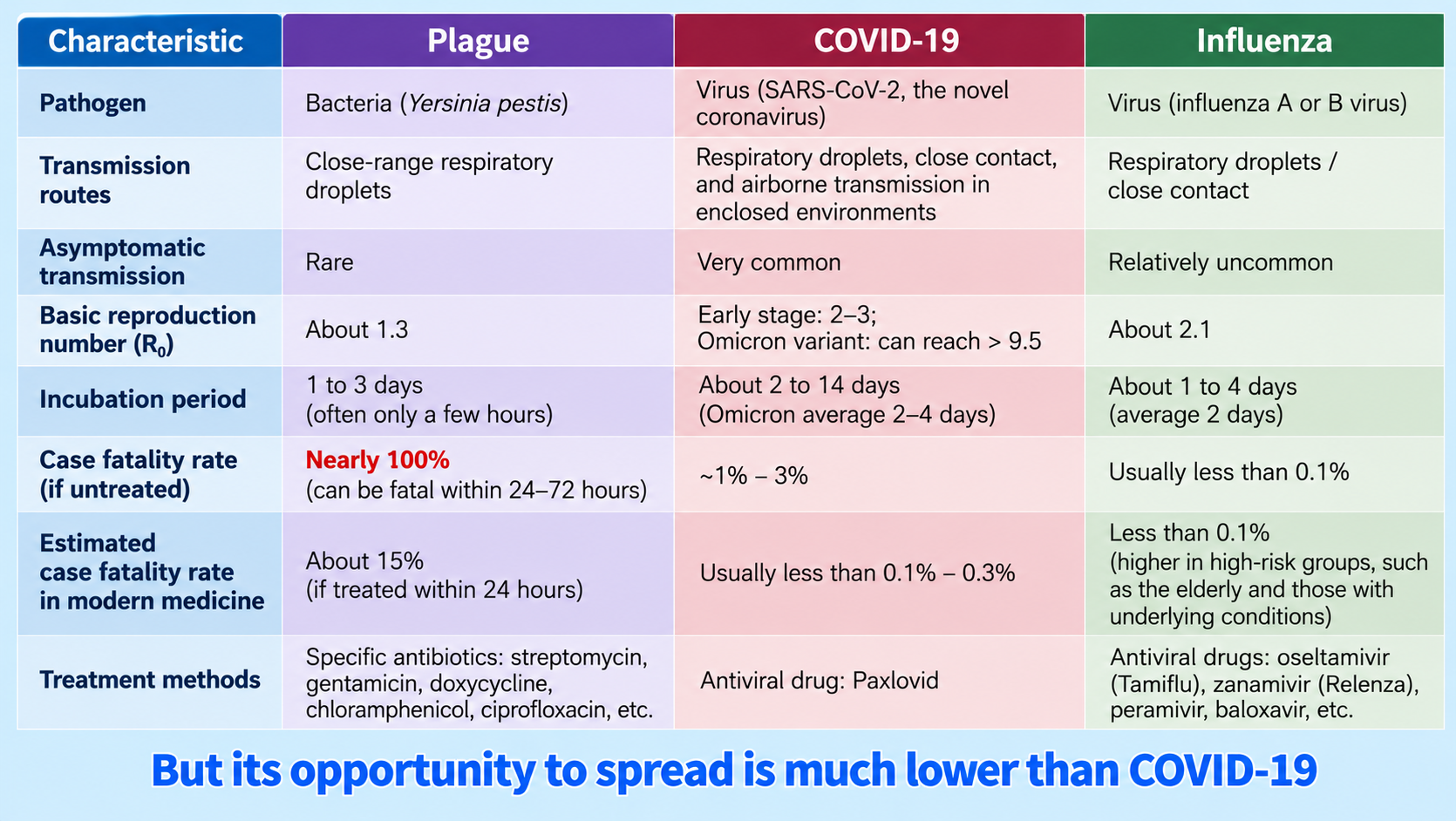
Plague spreads much less easily than COVID-19 (R₀ about 1.3, no common asymptomatic transmission), but untreated case fatality approaches 100% and modern treatment saves most patients only when it starts early — which is why the clock rules in Section 5 matter.
2. Baseline behavior when you are not in an outbreak
Most people, most of the time, need no special gear and no preventive antibiotics. The useful habits are the ones that already cut flea bites and animal contact.
Do
- Treat dead rodents, prairie dogs, marmots, rabbits, and sick pets that hunt rodents as contaminated. Do not skin, cook, or bury them with bare hands.
- In known plague country, use an insect repellent labeled for fleas and ticks, tuck trousers into socks, and avoid sitting on burrows or rodent nests.
- Keep pets from roaming rodent areas. If a cat or dog becomes suddenly ill after hunting rodents, call a veterinarian and do not let the animal cough or sneeze in your face.
- Wash hands with soap after any animal contact, and cover cuts before outdoor work.
Do not
- Do not buy or take antibiotics because a rumor is circulating and you have had no exposure.
- Do not treat a surgical mask, herbal product, or disinfectant fog as protection against a disease you have not been near.
- Do not share unverified “death in 18 hours, so buy this box” posts as if they were a personal order to medicate.
3. If you are in or traveling through a reported area
A reported area means a health authority has said human or animal plague is occurring there, or you are inside a quarantine zone. A headline is not the same thing as a reported area. Check the local health department, national CDC-equivalent, WHO, and your embassy travel alert.
- Postpone non-essential travel into an active human pneumonic cluster or a formal quarantine zone.
- If you must stay: avoid hospitals that are receiving suspected cases unless you are the patient or you are wearing the protection the facility requires. Crowded, poorly ventilated wards are the setting where droplet spread is most plausible.
- Keep about 2 meters from anyone coughing who has not been cleared. If you cannot, wear a well-fitted medical mask; a respirator (N95, KN95, FFP2) is preferable if you already have one and can wear it properly.
- Do not enter homes where a suspected pneumonic case is isolating, and do not attend funerals or body-washing for an unexplained pneumonia death in that setting.
- Food, water, and parcels are not the usual route. Ordinary cooking and handwashing cover that residual risk. Panic disinfection of streets does not.
- Healthcare and laboratory workers follow the facility plan: standard precautions plus droplet precautions for suspected pneumonic plague. A mask shortage, overcrowding, or failed ventilation is an occupational problem for the employer and the health authority, not a reason for the public to self-start drugs.
4. If someone in the household may be infected
Separate first, then get care. The goal is to cut face-to-face droplet exposure while one person goes for evaluation.
- Put the sick person in one room. Others do not sleep there. Open a window if the weather allows. Shared air with a coughing person is the problem, not doorknobs in general.
- The sick person wears a medical mask when anyone else is in the room and during transport. Caregivers wear a medical mask or respirator, and gloves if they will touch tissues, sputum, or laundry wet with respiratory secretions.
- One adult does the care. Everyone else stays out. No visitors.
- Call ahead before arriving at a clinic or emergency department. Say “suspected plague exposure” so staff can use droplet precautions. Do not sit in a crowded waiting room unannounced if you can avoid it.
- Bag laundry and tissues. Wash hands with soap after removal of a mask or gloves. Ordinary detergent is enough for clothes. Do not shake dirty linen.
- Household contacts of a pneumonic case should expect medical observation for about 7 days and a decision on preventive antibiotics from a clinician or public-health team. That decision is not yours to invent from a group chat.
5. When to seek care
Go the same day, and go now if breathing is already involved. Plague is a statutory emergency in many countries. Clinicians are told not to wait for a culture before starting effective antibiotics. Your job is to arrive and state the exposure.
Go now — emergency department
| Pattern | Why it cannot wait |
|---|---|
| Fever plus cough, shortness of breath, chest pain, or coughing blood, after close contact with a suspected pneumonic case or a sick animal | Pneumonic disease can deteriorate within hours. This is the 18-to-24-hour window people quote. |
| Fever plus a painful, swollen lymph node (groin, armpit, or neck), especially after a flea bite or handling a rodent in an endemic area | Classic bubonic presentation. Early care is what drops the historical death rate. |
| High fever, vomiting, confusion, bleeding, or collapse after a plausible exposure, even with no bubo and no cough | Septicemic plague may have no obvious local sign. |
| Any of the above in a child, a pregnant person, or someone who is already short of breath | Same disease, less reserve. Do not trial home remedies overnight. |
Seek care the same day, do not self-watch overnight
- You had close, unprotected contact (about 2 meters, more than a passing moment) with a person later said to have pneumonic plague, even if you feel well. You need a public-health assessment, usually including 7 days of observation and a decision on preventive antibiotics.
- You handled a dead rodent or were bitten by fleas in a known endemic focus and now have any fever.
- You work in a laboratory or clinic that has told you there was an accidental exposure. Follow that institution’s exposure protocol the same shift, not the next morning.
Watch, and have a plan — not an emergency by itself
- You live in a city where a rumor is circulating, you have no animal contact, no flea exposure, and no contact with a sick person. Ordinary fever still deserves ordinary care. It does not, by itself, mean plague.
- You wore a proper mask and droplet precautions while briefly near a suspect patient, and the facility says contacts are being listed. Stay reachable, check your temperature, and follow the list rather than starting a parallel plan.
Temperature checks for named contacts are often every few hours for about a week. A new fever during that window is a reason to call the monitoring team or go in, not a reason to post about it and wait for replies.
What to say at the door
“I may have been exposed to plague. I have fever / cough / a swollen node. My exposure was [flea or rodent / close contact with a coughing patient / laboratory] on [date], in [place].”
Naming the exposure is more useful than naming the antibiotic you read about online.
6. What to tell the clinician
- Date and place of travel, or of the animal, flea, laboratory, or patient contact.
- Whether the contact was face-to-face and roughly how close and how long.
- First symptom and the hour it started, not just the day.
- Pets, hunting, skinning, camping, or a job in a plague laboratory or clinic.
- Pregnancy, age of a child, kidney disease, and drug allergies. Those change the regimen. They do not change the decision to be seen.
7. Behavior that wastes the window
| Impulse | Better move |
|---|---|
| Search group chats for a dose and start leftover antibiotics | Go in. The wrong class of antibiotic is a known failure mode. Beta-lactams are not reliable for this infection. |
| Wait for a PCR or culture before leaving home | Clinicians are instructed to treat on suspicion. Waiting for confirmation is their error only if you never arrive. |
| Stockpile boxes with no exposure | Creates shortages for people who have a real indication, and does not protect you tonight. |
| Rely on a cloth mask at 30 centimeters from a coughing suspect | Distance first. If you must be close, a fitted medical mask or respirator, and then leave. |
| Hide the exposure because plague sounds stigmatizing | Say it. Isolation and contact tracing are the control measures. Silence is how a household cluster starts. |
8. Note on reports from Irkutsk, October 2026
As of 7 October 2026, a laboratory worker at the Irkutsk Anti-Plague Research Institute had died of severe pneumonia of unestablished cause. Early media reports alleged a broken tube and pneumonic plague. Russian authorities told WHO that no plague case had been registered in Irkutsk oblast, that identified contacts were tested and observed, and that no high-threat pathogen was found among them. WHO has asked for more information on the cause of the pneumonia and on reports of a second employee with pneumonia. The U.S. Embassy in Moscow issued a health alert and restated its existing advice that Americans leave Russia.
For personal behavior, that status means: do not treat Irkutsk as a confirmed community outbreak, and do not treat the absence of a final cause as a reason to ignore a real exposure if you were actually a named contact. Named contacts follow the local observation order. Everyone else follows Section 2.
9. Sources used for the behavior rules
- U.S. CDC, Clinical Care of Plague, and the 2021 MMWR recommendations on treatment and prophylaxis (timing, droplet precautions, who needs post-exposure assessment).
- WHO public descriptions of plague transmission, the value of treatment within about 24 hours, and contact precautions for pneumonic disease.
- China National Health Commission and National Administration of Traditional Chinese Medicine, Plague Diagnosis and Treatment Plan (2023 edition): early recognition, isolation, and the same transmission routes.
- WHO statements on 6–7 October 2026, and contemporaneous reporting on the Irkutsk laboratory death, for the situation note only.
Use the interactive map to see what has been reported and sourced. For medication and treatment principles, see Medication and treatment.
If this page conflicts with an instruction from the health authority that has listed you as a contact, follow that instruction.