
Plague: Medication and Treatment Principles
Clinician-directed antibiotics, post-exposure prophylaxis, and critical timing windows. Drug doses are deliberately left out of this document.
Read this first
Plague is a bacterial infection caused by Yersinia pestis. It is treatable with antibiotics when recognized early. Untreated pneumonic plague can kill within about 18 to 24 hours of the first symptoms. Clinicians are instructed to start effective antibiotics on suspicion, without waiting for a culture — because waiting for laboratory confirmation is exactly how the treatment window is lost.
Your job is not to select the drug. Your job is to arrive and state the exposure.
An at-a-glance reference to everything on this page — how the drug is chosen, treatment by clinical type, and the 7-day post-exposure prophylaxis (PEP) course:
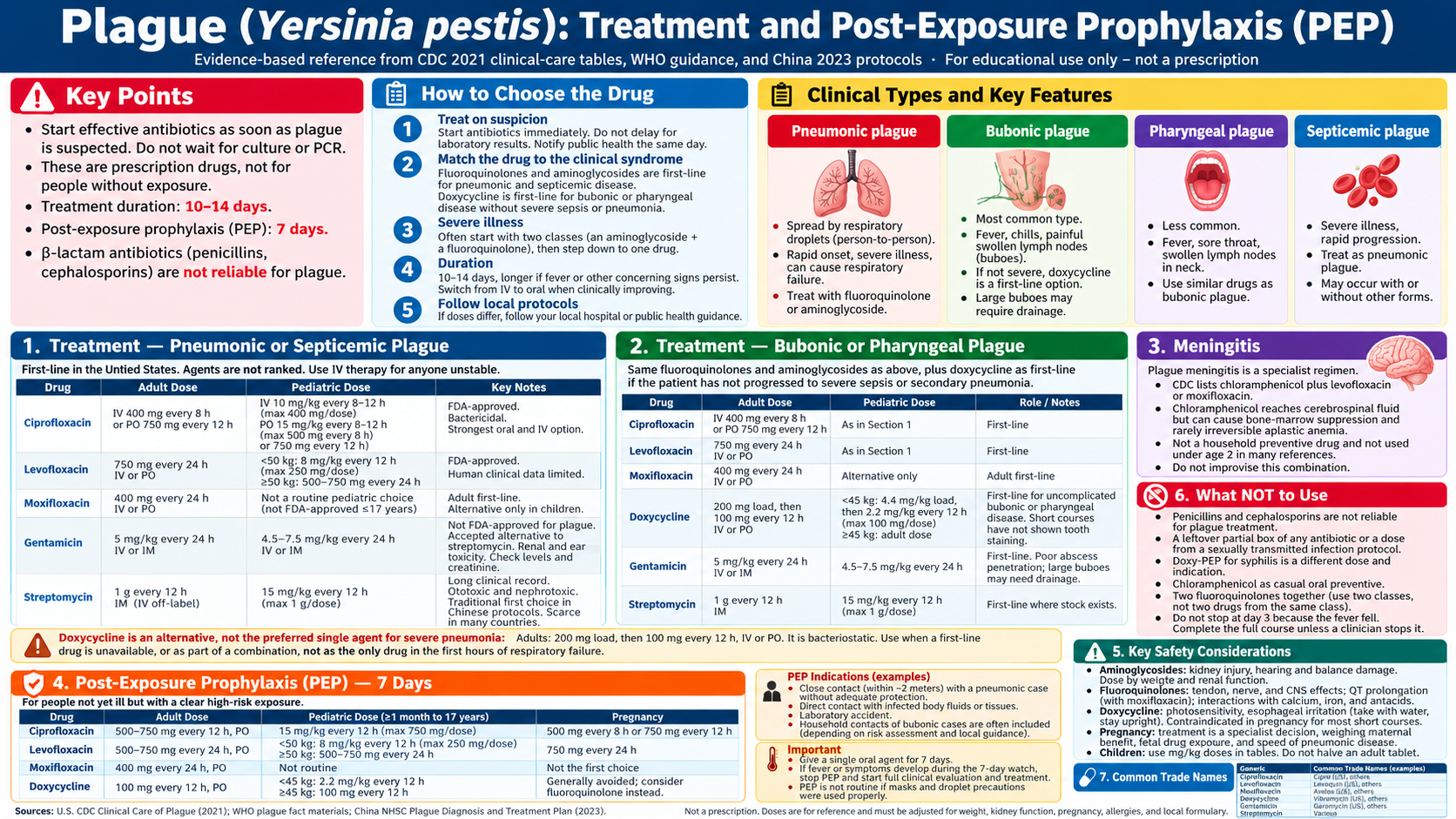
Compiled from CDC 2021 clinical-care tables, WHO guidance, and China's 2023 protocol — educational use only, not a prescription. It shows why clinicians treat on suspicion, match the drug to the clinical syndrome, and give named contacts a 7-day PEP course; the dosing decisions belong to the treating clinician.
1. Who decides on medication
- The drug, the regimen, and the duration are chosen by a clinician or public-health team, based on the plague form (bubonic, septicemic, pneumonic), disease severity, patient stability, and local statutory protocols.
- Pregnancy, the age of a child, kidney disease, and drug allergies change the regimen. They do not change the decision to be evaluated immediately.
- Healthcare and laboratory workers follow their facility's exposure protocol — the same shift, not the next morning. A mask shortage or failed ventilation at a facility is an occupational hazard for the employer and health authorities, not a reason for the public to self-start prescription drugs.
2. Preventive antibiotics (prophylaxis)
Preventive antibiotics are ordered after a professional risk assessment, not self-initiated from rumors or group chats:
- Household and close contacts of a pneumonic case should expect medical observation for about 7 days and a decision on preventive antibiotics from a clinician or public-health team. That decision is not yours to invent.
- Healthcare and laboratory workers with a confirmed or plausible exposure follow the formal institutional exposure protocol.
- Temperature checks for named contacts are often required every few hours for about a week. A new fever during that window is a reason to call the monitoring team or go in immediately — not a reason to post about it and wait for replies.
If you had close, unprotected contact (usually within about 2 meters, more than a passing moment) with a person later diagnosed with pneumonic plague, you need a public-health assessment even if you currently feel entirely well.
3. Behaviors that waste the treatment window
Plague moves on a biological clock. Certain common impulses can cost the few hours that separate recovery from rapid collapse:
| Impulse | Better move |
|---|---|
| Search group chats for a dose and start leftover antibiotics | Go in. The wrong class of antibiotic is a known failure mode. Beta-lactams are not reliable for this infection. |
| Wait for a PCR or culture before leaving home | Clinicians are instructed to treat on suspicion. Waiting for confirmation is their error only if you never arrive. |
| Stockpile boxes with no exposure | Creates shortages for people who have a real indication, and does not protect you tonight. |
| Hide the exposure because plague sounds stigmatizing | Say it. Isolation and contact tracing are the control measures. Silence is how a household cluster starts. |
4. Why there is no drug list on this page
- Wrong drug class, incorrect dosage, delayed in-person care, or false reassurance from ineffective home stockpiles can all cause rapid fatality.
- Publishing a consumer drug menu encourages unsafe self-treatment and goes beyond an independent public health map's role.
Our role is to map verified reports, chronology, and status; your healthcare clinician's role is to evaluate and prescribe.
5. What to tell the clinician
Arriving with clear facts shortens the path to the correct antibiotic regimen and prevents lost time:
- Date and place of travel: or specific details regarding flea, animal, laboratory, or suspected patient contact.
- Contact proximity: whether contact was face-to-face, unmasked, and roughly how close (within 2 meters) and for how long.
- Exact symptom timeline: the first symptom and the specific hour it started, not just the calendar day.
- Occupational or outdoor history: pets, hunting, skinning, camping, or duties in a infectious disease clinic or lab.
- Physiological factors: pregnancy, pediatric age, renal impairment, and existing drug allergies.
6. Sources used for the medication rules
- U.S. CDC, Clinical Care of Plague, and the 2021 MMWR recommendations on treatment and prophylaxis (timing, droplet precautions, who needs post-exposure assessment).
- WHO public descriptions of plague transmission, the value of treatment within about 24 hours, and contact precautions for pneumonic disease.
- China National Health Commission and National Administration of Traditional Chinese Medicine, Plague Diagnosis and Treatment Plan (2023 edition): early recognition, isolation, and clinical treatment standards.
For everyday avoidance of fleas, animals, and sick contacts — and for when to seek care — see Behavioral protection and when to seek care. Use the interactive map to see what has been reported and sourced.
If this page conflicts with an instruction from the health authority that has listed you as a contact, follow that instruction.